

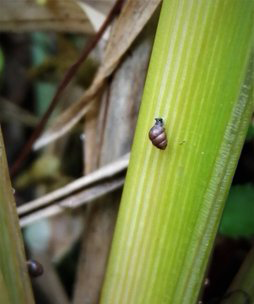
The Desmoulin’s Whorl Snail (Vertigo moulinsiana) is one of the most highly protected invertebrates in the UK and is listed as vulnerable on the IUCN Red List. The River Wensum is a Special Area of Conservation (SAC) and the Desmoulin’s Whorl Snail is a qualifying feature for this designation.
This tiny snail species is 2-2.5mm in height, barely noticeable to the naked eye. They can be found on the stems and leaves of reed-grasses and sedges, such as reed sweet-grass (Glyceria maxima), greater pond-sedge (Carex riparia) and lesser pond-sedge (C. acutiformis).
Toby Abrehart from Abrehart Ecology has been monitoring the River Wensum area for Desmoulin’s Whorl Snails for the past 25 years. Baseline data was established across the Wensum Valley in 2001. Here at Sculthorpe Moor, 1 individual was recorded in 2001. The area was surveyed again in 2017 where there were 3 individuals. A site visit was conducted in 2025/6 and there were 3 different populations established, with 429 individuals recorded. 188 individuals were recorded in one sample alone which is said to be the highest density recorded on the Wensum. Abrehart deemed this a “dramatic recovery at Sculthorpe Moor linked to beaver activity”.
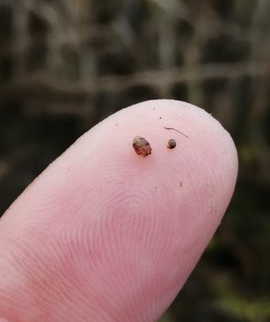
The decline in this species is linked to habitat loss, with the species dispersal rate less than 5m per year, they cannot recolonise and recover. Beavers are ecosystem engineers known for creating wetland habitats providing the perfect conditions for the Desmoulin’s Whorl Snail to thrive. We have lost 90% of our wetland habitats in the UK in the last 100 years so the restoration and creation of new wetland habitats is essential in protecting these vulnerable species. The wetland habitat created by the beavers provides the variety of vegetation favoured by the snails, providing food and shelter. They also create the consistently damp and humid conditions required for this species to survive.
Future surveys will be essential in monitoring this vulnerable species at Sculthorpe Moor and to show us how the beavers are having an effect on local biodiversity.
Source: Abrehart Ecology: https://www.abrehartecology.com
Abrehart Ecology’s full report can be found here: https://www.abrehartecologyltdsussex.com/post/desmoulin-s-whorl-snail-on-the-river-wensum-sac